
History doesn’t repeat exactly, but certain patterns recur. The episodes below show how power, money, fear, or crisis have been used before to justify eroding democratic rights — and how people recognized it and pushed back. Skim the section that resonates most; each entry stands on its own. Interested in some current government actions that repeat these episodes?
Table of Contents
- Concentrating Power & Wealth — from the birth of the income tax to the French Revolution
- The Gilded Age & the Progressive Response (1870s–1913)
- The French Revolution & the Cost of Untaxed Wealth (1789)
- Silencing Dissent & the Press — McCarthyism, the Pentagon Papers, and the cost of staying silent
- McCarthyism & the Second Red Scare (1950–1954)
- The Pentagon Papers & Prior Restraint (1971)
- Attacking Knowledge, Culture, & Learning — book burnings, banned science, and purged faculty
- Nazi Book Burnings (1933)
- The Scopes Trial (1925)
- The California Loyalty Oath Controversy (1949–1952)
- Targeting Groups Under Cover of Crisis — what the Japanese American incarceration teaches us
- Executive Order 9066 & the Japanese American Incarceration (1942)
- Pressuring the Courts — FDR’s 1937 attempt to reshape the Supreme Court
- 1937 Court-Packing Plan
The Gilded Age & the Progressive Response (1870s–1913)
What it was: Rapid industrialization created enormous new fortunes — the “robber barons” of railroads, steel, and oil — alongside sweeping poverty and dangerous working conditions for everyone else. Populists, and later Progressives, pushed for a Federal income tax that would fall most heavily on the enormous new fortunes of the era, rather than relying on consumption taxes that fell most heavily on ordinary people. The effort was blocked by the Supreme Court in 1895, but persisted — and in 1913, the 16th Amendment established Congress’s right to impose a Federal income tax, settling the question.
Is Greed Good?
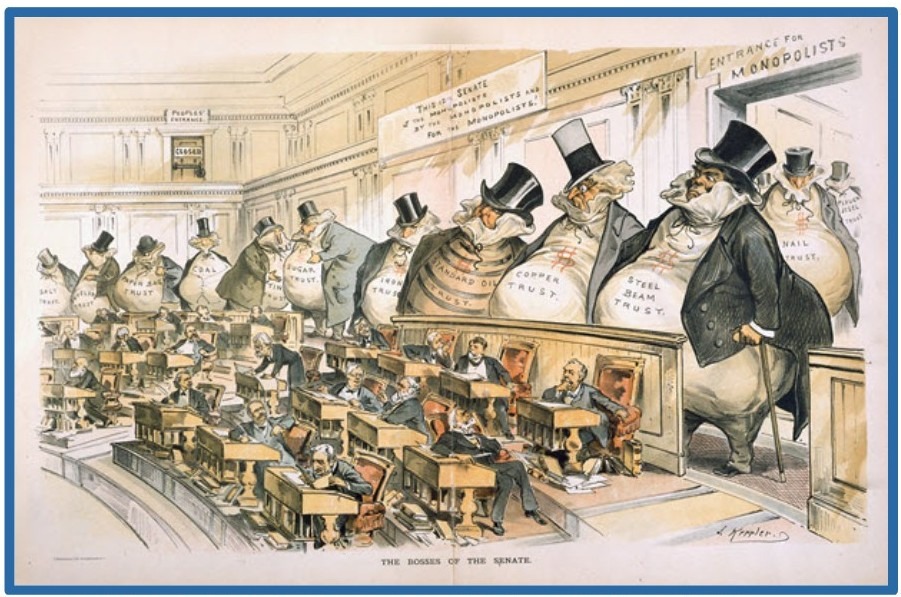
The Bosses of the Senate — tiny senators dwarfed by giant money-sacks labeled Standard Oil Trust, Sugar Trust, Copper Trust, Iron Trust, Coal Trust, and others, standing in for the interests actually running the room. Puck, January 23, 1889; J. Ottmann Lith. Co. after Joseph Keppler. Public domain, Library of Congress. Framing question “Is Greed Good?” from 8th Grade Gilded Age Inquiry, New York State Social Studies Resource Toolkit, C3 Teachers — CC BY-NC-SA 4.0.
Why it matters today: Unlike the earlier French Revolution — the pattern’s other ending, the U.S. Congress recognized that runaway concentration of wealth was a threat to the country’s stability. A constitutional process — not collapse — was used to correct course. Worth knowing both halves of the pattern: what happens when the pressure is relieved, and what it looks like when it is not.
The French Revolution & the Cost of Untaxed Wealth (1789)
What it was: France’s nobility and clergy — the wealthiest classes — were exempt from the country’s main direct taxes, while the common people bore most of the burden, even as they faced skyrocketing bread prices and widespread fear of famine. By the 1780s, taxation absorbed 25–30% of the average person’s income while those most able to pay largely didn’t. The bourgeoisie — merchants, manufacturers, and professionals — had gained real financial power but remained excluded from the political power needed to change any of it.
Why it matters today: Worth knowing, because the pattern recurs: when wealth accumulates at the top while the rules for who pays keep shifting the burden downward, and the people bearing that burden have no real political voice to change it. The pressure doesn’t just disappear — it eventually breaks something. Watch for the gap between who benefits from a system and who’s asked to sustain it.
Source: Britannica — French Revolution
McCarthyism & the Second Red Scare (1950–1954)
What it was: Senator Joseph McCarthy led a campaign accusing Government employees, entertainers, and academics of secret Communist ties — often with no evidence. Congressional investigations conducted during this period would later be called “witch hunts” by critics. Thousands lost jobs or were blacklisted based on accusation alone, and books by suspected sympathizers were removed from libraries, with some even burned.
Why it matters today: The pattern is worth knowing, because it tends to repeat in recognizable form: guilt assigned by association rather than evidence, loyalty tests used to sort “real” citizens from suspect ones, dissent reframed as disloyalty, and institutions — universities, libraries, employers — pressured into policing belief rather than defending it. Senator Margaret Chase Smith’s 1950 “Declaration of Conscience” is remembered precisely because so few of her colleagues were willing to say so publicly at the time. Recognizing the pattern early is what makes it possible to resist. The courage to speak up is what makes change possible.
The Pentagon Papers & Prior Restraint (1971)
What it was: When the New York Times began publishing a leaked, classified history of U.S. involvement in Vietnam, the Government obtained a court order preventing the Times from printing more — the first time in American history the Government had successfully censored a newspaper in advance on national security grounds. The case moved to the Supreme Court within days. The Court held that the Government had failed to meet the heavy burden required to justify blocking publication before it happened, and the papers resumed printing.
Why it matters today: Worth knowing, because the pattern recurs: governments under pressure often reach first for controlling whether something gets published, not just how it’s characterized afterward — and courts have historically treated that kind of advance censorship as the most serious form of speech restriction there is. Watch for any effort to stop a story before the public ever sees it, rather than responding to it after the fact.
Nazi Book Burnings (1933)
What it was: In May 1933, university students across more than 20 German towns and cities publicly burned books they labeled “un-German” — works by Jewish authors, pacifist writings, and anything associated with leftist political movements. Works by Sigmund Freud, Helen Keller, and countless other writers ended up in the flames. The burnings symbolized the Nazis’ desire to remake German culture entirely around their own ideology.
Why it matters today: Worth knowing, because the pattern recurs: an ideology that can’t survive contact with certain ideas tries to remove those ideas instead. Historians regard the book burnings as a clear example of a regime moving to censor and control every aspect of a nation’s culture — and a warning sign that came years before the worst of what followed. Beware of the moment certain books, subjects, or scholars are declared not just wrong, but dangerous to know.
Source: United States Holocaust Memorial Museum — Nazi Book Burnings
The Scopes Trial (1925)
What it was: Tennessee’s Butler Act made it illegal for public school teachers to teach evolution. Biology teacher John Scopes was recruited by local boosters and defended by the ACLU specifically to challenge the law in court. Scopes was found guilty and fined $100, and the law remained on the books until 1967. The constitutional question wasn’t actually settled until the U.S. Supreme Court struck down a similar law forty-three years later.
Why it matters today: Worth knowing, because the pattern recurs: when a legislature decides a scientific subject is too threatening to teach, the fight rarely ends with one trial — it can take decades of legal battles for the classroom to catch back up to the science. Watch for laws that tell teachers what conclusions students are and are not allowed to reach.
Source: Britannica — Scopes Trial
The California Loyalty Oath Controversy (1949–1952)
What it was: Amid Cold War anti-communist fervor, the University of California’s Board of Regents required all faculty and staff to sign a loyalty oath disavowing membership in the Communist Party, or face losing their jobs. Thirty-nine professors — some nationally prominent — and 84 staff refused to sign, despite no evidence that any of them was a Communist. Fifty-five courses had to be canceled, and dozens of scholars declined UC job offers in protest. The California Supreme Court ultimately ruled in favor of the dismissed professors, finding the University’s oath had exceeded its legal authority, and they were reinstated with back pay.
Why it matters today: Worth knowing, because the pattern recurs: loyalty tests aimed at faculty rarely catch actual wrongdoing — the one UC researcher who actually was investigated and dismissed for Communist Party membership was caught by ordinary investigation, not the oath. What the oath did do was drive away talent and chill open inquiry. Watch for demands that scholars affirm belief, rather than simply do their jobs well.
Source: UCI School of Humanities — Sworn to Obey: The California Loyalty Oath Crisis and Academic Freedom
Executive Order 9066 & Japanese American Incarceration (1942)
What it was: Issued by President Franklin Roosevelt on February 19, 1942, this order authorized the forced removal of all persons deemed a threat to national security from the West Coast to “relocation centers” further inland. Two-thirds of the 125,000 people displaced were U.S. citizens. No charges were filed, and no one incarcerated could appeal.
Why it matters today: Worth knowing, because the pattern recurs: a real crisis creates real fear, and that fear is used to justify treating an entire group as suspect — based on ancestry or identity, not evidence — while due process is set aside as an inconvenience. A Federal commission that later investigated the incarceration concluded it was driven by “race prejudice, war hysteria, and a failure of political leadership,” not military necessity. Watch for the moment a group is asked to prove its loyalty that no one else is asked to prove.
The 1937 Court-Packing Plan
What it was: After the Supreme Court repeatedly struck down New Deal legislation, President Franklin Roosevelt proposed a bill to grow the Court from nine justices to as many as fifteen — effectively letting him appoint enough new justices to outvote the ones ruling against him. The Senate Judiciary Committee rejected it, warning it was “an invasion of judicial power such as has never before been attempted in this country” and that judicial independence from the other two branches was essential to constitutional government. The full Senate voted 70–20 to strip the plan from the bill entirely.
Why it matters today: Worth knowing, because the pattern recurs: a popular, newly reelected president with a frustrated agenda can be tempted to reshape the referee rather than accept its calls. What stopped it wasn’t the courts protecting themselves — it was Congress, including members of the President’s own party, refusing to go along. Watch for proposals to change the size or makeup of a court specifically because of how it’s been ruling.
Source: National Constitution Center — How FDR Lost His Brief War on the Supreme Court