
History doesn’t repeat exactly, but certain patterns recur. The political actions below show how the government today is using power, money, fear, or crisis to justify its attempts to enrich the rich and erode democratic rights—by restricting free press and silencing dissent, reducing the power of the courts, weakening culture and learning, and using invasion of privacy and the police to target entire groups.
Concentrating Power & Wealth
In 1889, this cartoon skewered a Senate that was owned outright by industry, especially the oil industry. On July 10, Trump repeated the old pattern.
July 10, 2026 news report: Same Cartoon, New Century: Whose Interests Get Protected?
The Trump administration finalized a rule stripping habitat protections from the Endangered Species Act — opening protected land to drilling and mining. “Trump Allows Habitat Destruction in Endangered Species Rollback.” Read the Bloomberg Law assessment.
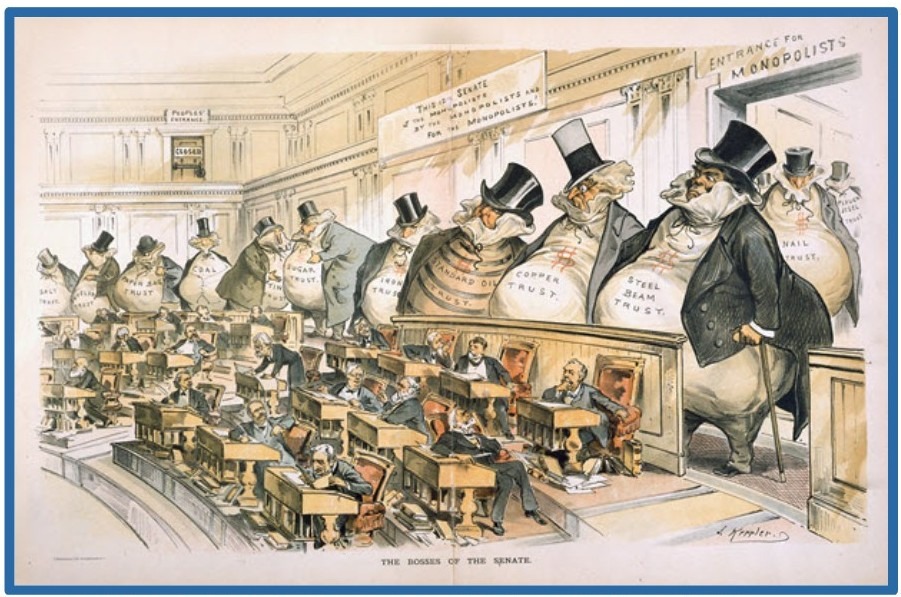
The Bosses of the Senate — tiny senators dwarfed by giant money-sacks labeled Standard Oil Trust, Sugar Trust, Copper Trust, and others. Puck, January 23, 1889; J. Ottmann Lith. Co. after Joseph Keppler. Public domain, Library of Congress.
Silencing Dissent, the Press, & the Courts
Reuters — generally viewed as a straight-news wire service — has reported that since returning to office, Trump and allies have described judges who ruled against his policies as “rogue,” “crooked,” or “lunatic,” while separately pursuing a systematic legal effort at the Supreme Court to narrow judicial review of executive power.
US falls to ‘historic low’ in press freedom tracker: Reporters Without Borders (RSF)
New York Times March 2026: Courts overturned Defense Secretary Pete Hegseth press policy. He had made Pentagon press passes available since October only to people who signed agreements not to solicit information the Trump administration has not approved for release. The New York Times had filed suit in the name of one of its national security reporters, Julian E. Barnes. Strikingly, multiple large news outlets had declined to risk joining the litigation, although the Pentagon Press Association filed a friend-of-the-court brief.
Attacking Knowledge, Culture, & Learning
Pen America tracks book bans and campus/faculty actions in detail. Their tracking found 6,870 book bans enacted during the 2024–25 school year across 23 states and 87 school districts. Their 2026 outlook flags weaponization of Federal research funding and visa approvals against universities, alongside continued state-level censorship legislation.
“Academic Freedom in the US Under Threat”: Human Rights Watch published in March 2026 a report drawing a historical comparison between academic freedom under Indonesia’s Suharto regime — which described political screening of faculty and restrictions on campus speech, and suggesting parallels to current conditions in U.S. higher education.
The Trump administration announced 7/16/26 that it is scrapping a decades-old policy that allows international students, cultural exchange visitors, and journalists to remain in the US. Educational programs exceeding four years (such as Ph.D. tracks or specific research programs) now require a formal Extension of Stay (EOS) application filed directly with USCIS rather than being handled by the university. The updated policies restrict the length of authorized stays, require formal government extensions, reduce grace periods, increase filing fees, and mandate more rigorous in-person interviews and social media vetting.
Targeting Groups Under Cover of Crisis
The ACLU’s immigration-enforcement litigation tracker provides many examples of targeting groups.
Another example, published by ProPublica, is the blueprint for the Trump administration’s unprecedented plan to turn over IRS records to Homeland Security in order to speed up the ICE agency’s mass deportation efforts.